Combate Racismo Ambiental » Em Frankfurt, Daniel Munduruku diz que governo Dilma é retrocesso; e Manuela Carneiro da Cunha e Lilia Moritz Schwarcz criticaram bancada ruralista:
'via Blog this'

Mostrando postagens com marcador literatura. Mostrar todas as postagens
Mostrando postagens com marcador literatura. Mostrar todas as postagens
segunda-feira, 14 de outubro de 2013


quarta-feira, 2 de outubro de 2013
terça-feira, 1 de outubro de 2013
sábado, 28 de setembro de 2013
Edgar Allan Poe
[14 de 100] O terror psicológico de Edgar Allan Poe
http://www.revistabrasileiros.com.br/2013/09/26/14de-100-o-terror-psicologico-de-edgar-allan-poe/
sexta-feira, 27 de setembro de 2013
segunda-feira, 12 de agosto de 2013
Summer voyages: The Expedition Of Humphry Clinker by Tobias Smollett
Summer voyages: The Expedition Of Humphry Clinker by Tobias Smollett
A holiday journey around 18th-century Britain is irresistably sweet
 Email
Email
'Sumptuous palace' ... Royal Crescent, Bath. Photograph: Trevor Smithers/Getty
It's a profound shame that the reputation of Tobias Smollett (1721-1771) seems to be waning. A few generations ago, he was part of the quartet of Great 18th-century Novelists, alongside Samuel Richardson, Henry Fielding and Laurence Sterne. George Eliot paid tribute to him in Middlemarch, when Brooke advises Casaubon: "Or get Dorothea to read you light things, Smollett – Roderick Random, Humphry Clinker. They are a little broad, but she may read anything now she's married, you know. I remember they made me laugh uncommonly – there's a droll bit about a postilion's breeches." Thackeray, in his English Humorists (overlooking the fact that Smollett was born in Dunbartonshire) wrote that: "The novel of 'Humphry Clinker' is, I do think, the most laughable story that has ever been written since the goodly art of novel-writing began". Robert Burns praised the "incomparable humour" of Smollett; Hazlitt called Humphry Clinker "the most pleasant gossiping novel that ever was written".
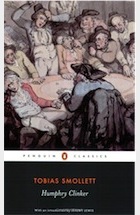
The Expedition Of Humphry Clinker is an epistolary novel, in which Matthew Bramble, his nephew Jery Melford, his sister Tabitha, his niece Lydia and Winifred, Tabitha's maid, all send letters to their friends describing their holiday from Gloucester, to Bath, to London, to Harrogate, to Durham, Edinburgh, to Glasgow and back home. The zestful fun of the novel comes from the characters' radically different perspectives on the places they visit. For example, the curmudgeonly Bramble is less than taken with Bath: "They look like the wreck of streets and squares disjointed by an earthquake, which hath broken the ground into a variety of holes and hillocks; or as if some Gothic devil had stuffed them altogether in a bag, and left them to stand higgledy piggledy, just as chance directed. What sort of a monster Bath will become in a few years, with those growing excrescences, may be easily conceived". Lydia, by contrast, says "Bath … to be sure, is an earthly paradise. The Square, the Circus, and the Parades, put you in mind of the sumptuous palaces represented in prints and pictures; and the new buildings, such as Princes-row, Harlequin's-row, Bladud's-row, and twenty other rows, look like so many enchanted castles, raised on hanging terraces." The Expedition Of Humphry Clinker begins the tradition of the novel as tourism. It is also the first to capitalise on the idea of multiple perspectives (although Christopher Anstey had pioneered the form in his New Bath Guide). With Humphry Clinker, we have the beginnings of the ironic polyphony that Bakhtin thought characterised the novel as a form.
There is a plot – involving romances, an illegitimate child, and the delightful Lieutenant Obadiah Lismahago – but on the whole it conforms to Walter Scott's dictum "what the deuce is a plot for except to bring in good things?" There are disquisitions on the Enlightenment, Methodism, the Union, the freedom of the press, and copious accounts of the different forms of hospitality available in each place (oysters kept in "slime-pits" in Colchester, the English visitors trying to deal with "haggice" – "a mess of minced lights, livers, suet, oat-meal, onions, and pepper, inclosed in a sheep's stomach, had a very sudden effect upon mine", the dreadful adulterated milk at Covent Garden). Smollett indulges in a little proto-postmodernism when Ferdinand Count Fathom, from his previous novel of that name, makes an appearance. Although the idea of the malapropism is conventionally linked to Sheridan's 1775 play The Rivals, it typifies the letters sent by the servant Winifred: "Oh Molly," she writes "you that live in the country have no deception of our doings in Bath", and she revels in "the very squintasense of satiety" they enjoy. "Matrimony" becomes "Mattermoney", as if to prefigure Jane Austen. She means more than she realises.
Sterne caricatured Smollett as "Smelfungus", on account of his irascible, cynical sarcasm: although Bramble begins very much in that vein, part of the charm of Humphry Clinker is in seeing how Bramble is himself charmed, becoming mellower over the course of the novel. Scott, in his biography of Smollett writes that "notwithstanding the general opinion denies that quality to his countrymen, Smollett excels in broad and ludicrous humour. His fancy seems to run riot in accumulating ridiculous circumstances one upon another, to the utter destruction of all power of gravity; and perhaps no books ever written have excited such peals of inextinguishable laughter as those of Smollett."
The voyage, Smollett suggests, is a chance to change: the Caledonian trip makes Bramble and his companions realise their prejudices about the Scots in particular, and anyone different in general. This was politically quite bold. At the time of publication, John Wilkes was stoking up anti-Scottish feeling in the pages of the North Briton, and Horace Walpole claimed that Humphry Clinker was "the profligate hireling Smollett" attempting to "vindicate the Scots". What he was doing was proving that the novel was a form that could create sympathy.
Byron, in Childe Harold's Pilgrimage, wrote of the "double joy" of admiring a landscape with a loved one. There's a quintuple joy in The Expedition of Humphry Clinker, as we learn to love these often eccentric, sometimes delusional, sometimes incisive characters and see 18th-century Britain through their eyes.


sábado, 20 de julho de 2013
CRÍTICA DA RAZAO PURA
Ronaldo Livros de Bolso
CRÍTICA DA RAZAO PURA
Saturday, July 20, 2013, 4:00 pm
A filosofia crítica kantiana tenta responder às questões: “Que podemos conhecer?” Que podemos fazer?” Que podemos esperar?” e remete a razão ao centro do mundo, como Copérnico remetia o Sol ao centro do sistema planetário. Kant põe em movimento a revolução copernicana no domínio prático.Crítica da Razão Pura (1781) realiza esta revolução metodológica e mostra como o entendimento, legislando sobre a sensibilidade e a imaginação, torna possível uma física a priori.Crítica da Razão Pura é a obra-prima de Kant. Seus efeitos se fazem sentir ainda hoje na investigação filosófica e científica.
Sobre o Autor
KANT, IMMANUEL
Immanuel Kant foi profundamente imbuído dos ideais do Iluminismo. Professou uma simpatia pelos ideais da Independência Americana e da Revolução francesa. Foi pacifista convicto, antimilitarista e estranho a toda a forma de patriotismo exclusivista. As obras de Kant costumam distribuir-se por três períodos, que habitualmente se denominam pré-crítico, crítico e pós-crítico. As suas obras mais conhecidas e influentes foram escritas no segundo período.
sexta-feira, 12 de julho de 2013


quarta-feira, 3 de julho de 2013
quinta-feira, 23 de maio de 2013
FESTA LITERÁRIA - PARATY
A 11ª Festa Literária Internacional de Paraty (Flip) será menos pop,
mais "cabeça", com autores experimentais, e mais interdisciplinar,
incluindo mesas com arquitetos, historiadores de arte, cineastas e
músicos. A programação completa foi divulgada na manhã desta quinta
(23), no Rio.
A principal atração da Tenda dos Autores na festa, de 3 a 7 de julho, em
Paraty (RJ), será o francês Michel Houellebecq, vencedor do Prêmio
Goncourt e autor de "A Carta e o Território" (Record), que em 2011
chegou a confirmar presença na Flip, mas acabou cancelando a
participação.
Entre os nomes que ainda não haviam sido anunciados, estão o americano
Tobias Wolff, que dividirá mesa com o norueguês Karl Ove Knausgard, e o
escritor e editor italiano Roberto Calasso, em debate com a filósofa
suíça radicada no Brasil Jeanne Marie Gagnebin
Programação da Flip

|
Programação da Flipby Eduardo Coelho |

A programação
da Festa Literária Internacional de Paraty foi anunciada. Eis os
autores: Aleksander Hermon, Alice Sant'Anna, Ana Martins Marques, Bruna
Beber, Cleonice Berardinelli, Daniel Galera, Dênis de Moraes, Eduardo
Coutinho, Eduardo Souto de Moura, Erwin Torralbo, Francisco Bosco, Geoff
Dyer, Gilberto Gil, Jeanne-Marie Gagnebin, Jérôme Ferrari, John
Banville, John Jeremiah Sullivan, José Luiz Passos, Karl Ove Knausgard,
Laurent Binet, Lila Azam Zanganeh, Lourival Holanda, Lydia Davis, Mamede
Mustafa Jarouche, Maria Bethânia, Marina de Mello e Souza, Michel
Houellebecq, Milton Hatoum, Miúcha, Nelson Pereira dos Santos, Nicolas
Behr, Paul Goldberger, Paulo Scott, Randal Johnson, Roberto Calasso,
Sergio Miceli, T.J. Clark, Tamim Al-Barghouti, Tobias Wolff, Wander Melo
Miranda, Zuca Sardan.
A Feira do Livro de Madri começa nesse mês de maio

|
A Feira do Livro de Madri começa nesse mês de maioby Fernanda Jimenez |
A 72ª edição da Feira do Livro de Madri começará no dia 29 de maio e vai até 16 de junho. A lista dos escritores que participarão da Feira já está disponível no site da Feira. Esse
ano não vai ter país convidado, o que é uma pena, pois deixamos de
conhecer autores de outros países. Será a crise? De todas as formas,
podemos visitar 353 stands no Parque del Retiro, pulmão verde bem no
centro de Madri.
Esse é o cartaz oficial de 2013 feito pelo desenhista e fotógrafo argentino radicado na Espanha, Juan Gatti:

Eu amo essa Feira, todos os anos participo ativamente, nela conheci muitos escritores famosos internacionalmente. Estou fazendo uma coleção de livros autografados. Esse ano vou querer autógrafo de Ildefonso Falcones
que vai autografar seu último livro "A rainha descalça", ele é o
escritor da bela narrativa "A catedral do mar". Vou aqui fazendo a minha
listinha de desejos!
quarta-feira, 22 de maio de 2013
?OES!A
|
|
?OES!Aby Eduardo Coelho |

Recomendo aos leitores de Autores e Livros o site de Marcelo Diniz, onde há excelentes poemas visuais. O título de seu blog é ?OES!A.
sábado, 18 de maio de 2013
BERTRAND RUSSELL
BERTRAND RUSSELL: IS THE PRESENT KING OF FRANCE BALD?
On this day in 1872, a boy was born in Wales who would later grow up to pose many perplexing questions to the rest of the world. His name was Bertrand Russell, and he is remembered today as an important British philosopher, logician, mathematician, historian, and social critic. Russell held a good number of controversial beliefs in his lifetime and sometimes got into trouble for them. But he was a very influential thinker, and even contributed a great deal to the field of mathematics.
Yale University Press’ Little Histories collection is a family of books that takes a closer look at some of the most significant events, ideas, discoveries and people throughout history. As part of our ongoing coverage of the collection, here’s an excerpt from Nigel Warburton’s A Little History of Philosophy, a book that presents the grand sweep of humanity’s search for philosophical understanding from Socrates to Peter Singer.

‘Russell’s main interests as a teenager were,’ Warburton writes, ‘sex, religion and mathematics—all at a theoretical level. In his very long life (he died in 1970, aged 97) he ended up being controversial about the first, attacking the second, and making important contributions to the third.’
To put it very briefly, Russell got into trouble for his views on sex because he didn’t think it was all that important to be faithful to your partner. This naturally didn’t go down well with many people at the time. With religion, he was just as provocative—he believed that people only turned to it because they feared death. Finally, because of his keen interest in logic, a subject which straddles both philosophy and mathematics, he ended up making many important contributions to both fields.
Russell was deeply influenced by his godfather, John Stuart Mill, even though he never had a chance to speak to Mill properly since Mill died when Russell was still a toddler. ‘Reading Mill’s Autobiography (1873),’ Warburton explains, ‘was what led Russell to reject God’. And, like Mill, Russell had ‘an unusual and not particularly happy childhood’. His parents died when he was young, which meant he was cared for by his strict and rather distant grandmother. So he ‘threw himself into his studies and became a brilliant mathematician, going on to lecture at Cambridge University’.
One of the many things that Russell was interested in was the logical analysis of language. He wanted to scrutinise how our words actually relate to the world, and pinpoint what exactly made a statement true or false. With this goal in mind, Russell went on to develop his Theory of Descriptions. Warburton explains the theory as follows:
‘Take the rather odd sentence (one of Russell’s favourites) ‘The present king of France is bald.’ Even in the early twentieth century when Russell was writing there was no king of France. France got rid of all her kings and queens during the French Revolution. So how could he make sense of that sentence? Russell’s answer was that, like most sentences in ordinary language, it wasn’t quite what it seemed.
Here’s the problem. If we want to say that the sentence ‘The present king of France is bald’ is false, this seems to be committing us to saying that there is a present king of France who isn’t bald. But that surely isn’t what we mean at all. We don’t believe there is a present king of France. Russell’s analysis was this. A statement like ‘The present king of France is bald’ is actually a kind of hidden description. When we speak about ‘the present king of France’ the underlying logical shape of our idea is this:
(a) There exists something that is the present king of France.
(b) There is only one thing that is the present king of France.
(c) Anything that is the present king of France is bald.
[...] For Russell the sentence ‘the present king of France is bald’ is false because the present king of France doesn’t exist. The sentence suggests that he does; so the sentence is false rather than true. The sentence ‘The present king of France is not bald’ is also false for the same reason’.’
Sufficiently confused yet? This was simply one of many befuddling—yet profound—puzzles that Bertrand Russell devised in his lifetime to force us to re-examine what we think we know about language. He managed to do what every good philosopher does: take a good, hard look at our beliefs and ask ourselves why we believe the things we do.
Assinar:
Postagens (Atom)
